Showing posts with label Gardening. Show all posts

Saturday, October 13, 2012

Oh, the peppers!!

While the garden was, for the most part, pretty challenging, and not as productive as I would have liked it to be, one of the things that did great was the peppers.

We've had peppers to eat, peppers to give away, peppers to use in canning and peppers that (unfortunately) went bad because we just couldn't eat anymore peppers.  I did get worried at one point not too long ago though.  I had told most of the girls that I wanted to leave the cayenne peppers on the plants to turn red so I could dry them, but then the one person I didn't tell was the one out picking a couple of weeks ago, and she picked all the long green ones.  I was afraid the others wouldn't have enough time to finish growing and turn red before it turned off cold.  My fear was unfounded.
This is only a portion of the string of peppers.  It's quite long.  We just use regular thread and put the needle through the green cap, close to the top of the pepper.  If you ever wanted to do it for decorative purposes, you could string the peppers closer together, but I wanted them to dry as quickly as possible, so Bre left spaces between the peppers.  Once they are dry, we'll be able to grind them up and store them in an airtight container.

I've linked this post with the Farm Girl Friday Blog Fest.
Photobucket

I've also linked with the Homestead Barn Hop.


post signature

Tuesday, August 7, 2012

When things go wrong in the garden.

Gardening is wonderful.  You turn over the soil, or add compost, or whatever it is you do to prepare, then you plant the seeds and wait expectantly for those little shoots to appear.  It's so exciting when they do.  Everyone here loves to see the tiny plants poke up through the soil, and I'm certainly no exception.  Then you're even more excited to see things grow like crazy and put out their first blooms.  The girls and I take great pleasure in noticing the first little fruits or veggies that begin to form on the plant, and oftentimes we are overwhelmed with goodies when everything starts to ripen.

But then there are the days we notice something has been nibbling on the newly sprouted beans.  We see the first signs of powdery mildew on the squash, or the entire top of a tomato plant has been stripped of leaves and flowers.  We might notice that a cucumber plant has developed yellow spots on its leaves after several days of rain, or we might have to water constantly because it's been incredibly hot and there's no rain in sight. And then, there are the weeds.  You may begin to think the whole gardening thing is not all it's cracked up to be.

This year has not been an especially good one for the garden.  Not horrible mind you, we did have a fairly good start, but it's certainly not been a gardener's dream year.  We had a very mild winter, so the bugs have been horrible this year.  The squash bugs are everywhere, and don't let anyone tell you they only eat squash.  When there are a bunch of the little beggers, I've become convinced that they eat just about anything.  Also, we discovered a new little critter on our beans - I still have no idea what it was, but it was hungry.  The only bug I haven't had trouble with this year, although I've certainly had my share of trouble with it in the past, are hornworms.   Then, there was the weather.  Many gardeners down here put their gardens in early this year because they were convinced we were going to skip spring altogether and head straight into summer.  This was due in part to the mild winter, and in part to an unseasonably warm March.  I wasn't convinced.  When people spoke to me about gardening, or urged me to go ahead and start my garden, I kept telling them I didn't think a warm winter and March meant we were going to skip spring altogether.  I've lived in central NC my whole life - I figured we were in for a cool snap just any ol' time.  I've seen too many years where farmers worried when warm spells, followed by late frosts or freezes endangered their crops, to think that a warm March meant anything other than a temporary dip in the jet stream.  Sure enough, we got to about the middle of April and it got cold, and wet.  Things did mellow out for a bit, but then we got hot.  Very hot - as in, record breaking temperatures (not just highs, but also records for how many days it was consistently over 100), and not a drop of rain.  After a few weeks of that, we did get rain, and lots of it.  It's rained almost every day.  Certainly not normal for this time of the year.  Too much rain, coupled with heat, breeds all kinds of fungal problems in the garden. And though the plants may not like it that wet, the slugs sure do.  Yuck!
Then, there are the storms.  This was after a storm that I'm sure contained micro bursts. The rain was torrential, and things were being blown everywhere, in all directions.  At least in about a 1 block radius.  Outside of that there was little damage, but for those of us right here, it was pretty nasty.  The neighbor lost two trees in is front yard and half of one in the back.  Our corn took the biggest hit, but other plants in the garden were damaged as well, in addition to some things around the house and some of the trees in the back. The corn wasn't quite ready, so we lost it all.  
We did get 20lbs of potatoes.  I went ahead and pulled them since the plants were completely flattened, and though they were already on their way to finishing off, that just kind of sped it along.  Since they like to set tubers when soil temps are around 60-70 degrees, I think all the hot weather we got prevented a greater yield.  

All the negative things could certainly dissuade someone from wanting to bother with a garden, but there are positives too. What is less than complimentary weather-wise to one plant, is often great for another.  We may not have gotten the best crop of zucchini we've ever had, but we've already had a bumper crop of okra, with more coming in all the time.  And the rain may have caused fungal problems with our cucumbers, but when they were producing, they produced a lot and they didn't ever get bitter, even if we missed one and it grew very big.  A mild winter may have allowed for greater bug problems this year, but it also allowed for a great crop of garlic.  I'm sorry I can't find much good to say about squash (or any bad) bugs, but at least we learn more about them, and how to try and control them organically.
And then there's the satisfaction that gardening can bring.  Whether it be from a plate full of home-grown veggies that you're able to put in front of your family, or a beautiful view outside your kitchen window, gardening can bring a lot of blessings through all of the trials.

We've been able to put fresh veggies on the table each night, we've had enough to share a bit with friends and family, and I have some things preserved for use this winter.  While I'm certainly glad that I don't have to rely completely on what I've been able to grow this year in order to feed my family, I'm grateful for all that I have been able to produce in my garden, and I look forward to what we'll be able to do in the future.  

post signature

Sunday, July 8, 2012

Preserving the Harvest

This week has been pretty busy.  I did want to spend part of the summer reorganizing things in the house, and I have done a little of that, but cleaning the closet will wait, ripe fruit and vegetables will not.  With that in mind, I've spent a good part of the week preserving food and keeping on top of the garden.  The last of the onions have come out, so limas were planted.  We're getting plenty of cukes, and some of the tomatoes are ripening.  We've also been able to pick radishes, zucchini, and green beans.  We anxiously await all the watermelon that look so adorable right now, are happy that the okra is finally blooming, and can't wait to see how the corn and potatoes turn out. 
This is the largest of the watermelon. The pic was taken more than a week ago, so it's bigger now.
We choose to plant Sugar Baby this year.
Some of the zucchini has already made it through the food processor and into the freezer.
I love using the processor for this.  The grating blade makes very short work of the zucchini.
It's great to keep this on hand for zucchini bread, cake and muffins, but I also like to put shredded zucchini in soups, stews, and meatloaf.  You could probably slip it into spaghetti too, and no-one would be the wiser. Zucchini is so easy to grow, and you usually end up with a lot of it, so shredding and freezing it is an excellent way to preserve it. And keeping shredded zucchini on hand in the freezer is a perfect way to up the nutritional ante of some of your favorite dishes.
Though I didn't mention it before, we are also getting in some of the herbs.
Here we are drying sage in the dehydrator. It was finished by Saturday.
In the house we lived before, I would hang herbs to dry.  There were cut outs between the kitchen and dining room that had cross pieces to make them look like windows.  They were cute, but also useful.  That's where I used to hang my herbs.  I don't have anything like that here, and the drying rack takes up too much space to leave it out long enough for herbs to dry, so hubby got me the dehydrator.  I put it out in the garage to run so it doesn't add any heat inside the house.
We also visited a U-Pick blueberry field. 
After spreading the blueberries on cookie pans to freeze in a single layer, we bagged them up to store in the big freezer.
Well, we did that to some of them.  Others found their way into some pretty delicious jelly.
A few more pints of green beans were picked and processed earlier that day and stand in the back.  They've been added in with what was canned earlier in the week.

Learning to preserve the harvest is invaluable.  I would encourage everyone to do it.

I've linked this post with the Carnival of Home Preserving,

and with the Homestead Barn Hop.

post signature

Sunday, July 1, 2012

Urban Gardening

I will admit to being very blessed when it comes to the size of my yard.  We may not live in the country anymore, with acres for the children to run around in, but if we have to live just outside a fairly large city, at least we do have decent sized yards.  None of the properties in our development have lots smaller than one acre, and many are larger.  While there are some restrictions within the homeowners association with regard to what you can do on your property (ugh - they are highly restrictive of clotheslines), it doesn't restrict gardens, and several families in the neighborhood enjoy that as much as I do.  In fact, I read the restriction list through twice before we agreed to buy the house, just to make sure I could plant a garden.
The key to urban gardening though, is to make the best use of limited space.  While I certainly have more space than many urban gardeners, I can't just tear up the entire backyard and turn it into a garden.  For one, my hubby wouldn't like that - he wants to make sure the kids have plenty of room to play.  And, though the HOA doesn't restrict gardens, they do have a provision that says you have to keep your lawn attractive, and I'm not sure they would deem a plot of corn in the front yard attractive (beauty is in the eye of the beholder).  Also, while corn is a member of the grass family, it exceeds the maximum height they'll allow the grass to get by just a little. Thankfully, these restrictions don't really apply to the backyards - things just have to look "good from the road." (I'll just have to live with the shallowness of that.)
We've tried to make the most of our space by choosing a spot in the yard that didn't impede foot traffic, and was relatively out of the way for when the girls play in the back.  They are getting older now and don't do that as much anyway, but they've moved some of those games to the front yard as the garden grew in size.  Gotta love those girls.  We have also utilized the area around our deck, using the deck itself as a support system for vining plants, as an additional area to plant veggies and flowers.  I've found out that the small bed along one side of the back of the house is great for growing herbs, and the north side of the deck is perfect for shading mints.  I've also planted a few things among the flowers in the front beds and gotten away with it.
The newest picture of the main garden. I'll have to get pics of the other beds soon.
  We do try to keep it nice looking (oops - gotta fix that weed mat by the strawberry bed).  We don't want any complaints from the neighbors, and all our backyards open up on one another, so there would be no hiding it if we were negligent.
The mow line, you can see it between our garden and the neighbor's tree, roughly marks the edge of our property.  As you can tell (though the pic doesn't do justice to the true length), there's still room to put in more beds without moving the beds further into the backyard.

Future plans include planting blueberry bushes in the beds along the front of the house.  We pulled all the regular shrubs out this spring, and laid weed mat and pine needles in preparation for putting the blueberries in this fall if we can manage it.  We also want to plant several fruit trees in the back corners of our yard.  We love the little wooded area for the shade it offers the back, but there is some room to each side of that where we could put the new trees.  We might be able to put some on the north side of the house too, but we need utility workers to come mark where any lines have been buried before we can really plan that out.  Same for the front yard.  I'd like to plant blackberries in a line from the back corner of the house to the property line (on the north side, opposite the side with the driveway), effectively delineating the side yard from the back yard.  I think I could use this living fence as a way to help hide compost bins from view by most of the neighbors.  I would also love to have a small greenhouse, but that is something that would definitely have to be approved by the HOA.

I may have a large yard, and I am truly thankful for that, but all of these plans try to balance my desire to produce as much of my own food as possible, with the desire not to alienate any of the neighbors by turning the yard into what others could see as an eyesore.  We have some really good neighbors, and we knew the HOA rules before we bought the house, so we need to be respectful of the regulations and our neighbors by creatively using our space; keeping the area that can look like a garden neat, and finding ways to grow food in an attractive way that mimics standard plantings - like using the blueberries instead of regular shrubs for the foundation plantings.  
I'm not the only one in my family to have to find room for a garden.  Both my brothers and one of my cousins all have to fit gardens in restricted areas.  My younger brother utilizes the only area available to him by growing what veggies he can in pots on his deck.  You can see some of what he's done here, and here.  In the second link, the photos of his space saving ideas are near the bottom of the post.

Earlier this year I shared some of my favorite quotes on gardening.  Included was this one by Spencer W. Kimball: "Where you have a plot of land, however small, plant a garden.  Staying close to the soil is good for the soul."  I agree with this 100%.  There's immense satisfaction in producing your own food, or even your own flowers.  And that early morning watering time is a great time to pray.

I've linked this post with the Homestead Barn Hop.  As usual, there are some great links.

post signature

Tuesday, June 19, 2012

What a difference a week makes,

in the garden.

Romas, from this...
to this.
Please excuse the fact that this angle makes my hand look weirdly misshapen.
Peppers, from this...
to this.
The corn,
is now much taller.
And the potato bed,
has filled out quite a bit.

Boy, am I ever looking forward to harvesting time.
post signature

Monday, June 11, 2012

Garlic, gardening, and the results of growing kitchen scraps.

We were finally able to harvest our garlic.
The French Mild is on the left, and the Khabar is on the right.
The growing tips from Filaree Farms, where I got the seed, said to harvest when only the top four leaves were green, but I knew we had and unusually mild winter and the bulbs were already quite large.  I was afraid if I left them in the ground any longer the bulbs may begin to split and then they wouldn't keep well.
I was glad I made that call because a couple of the bulbs had started to split.  We'll just eat those first.
See?  Most of it was quite a bit bigger than store bought garlic - remember, I have large hands.
Here again the French Mild is on the left and the Khabar on the right. It looks like the French Mild is larger, but it's not.  The heads on it are just kind of flattened, so it's oblong as opposed to round.
We did start pulling some of the onions too.
Interestingly enough, some of the largest were ones we had planted (on an whim) in the openings of the concrete block.
We discovered this little volunteer tomato while we were getting the onions.  
Not sure he'll do good there.  That opening is kind of small for a tomato.
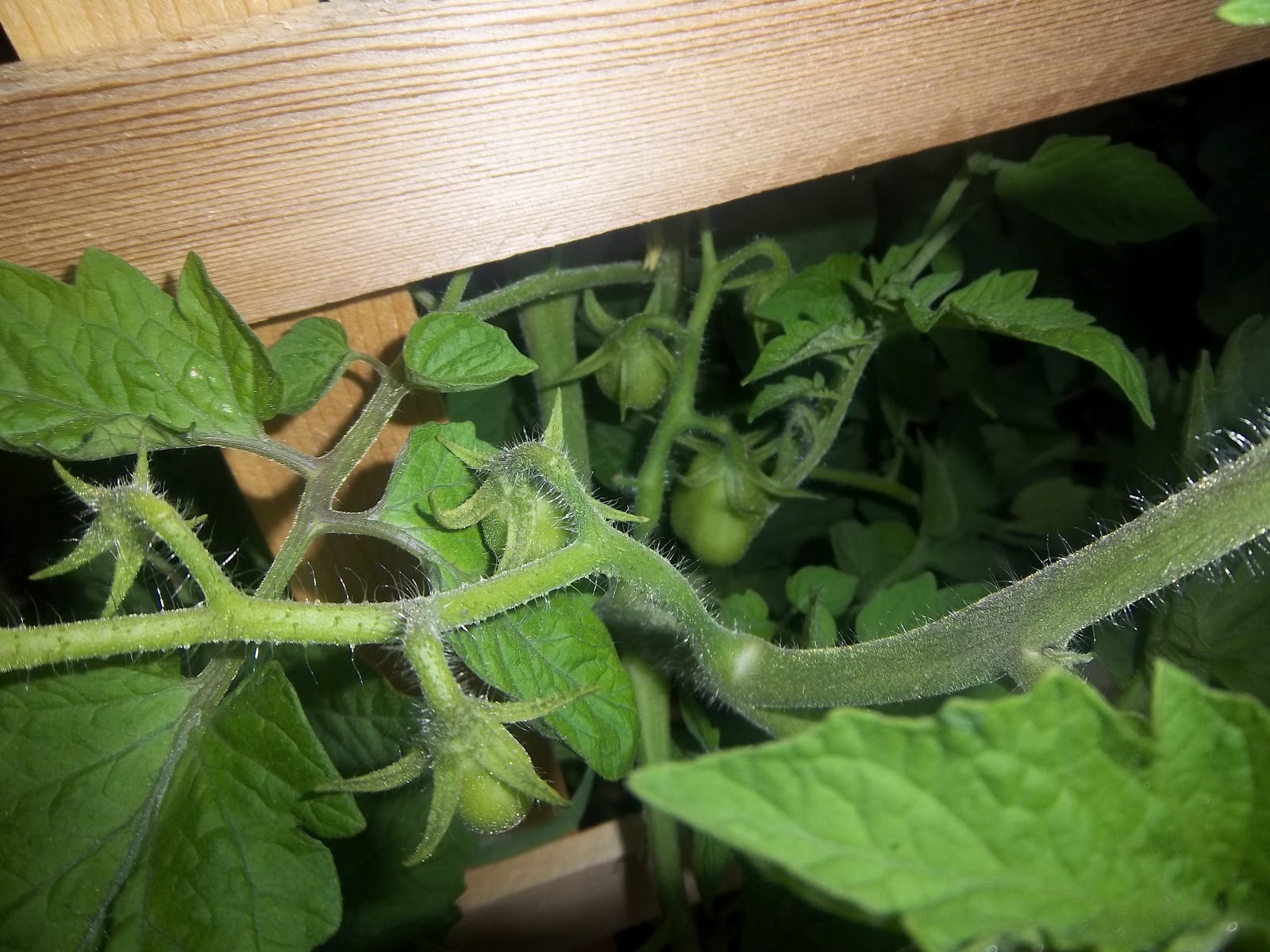
The tomatoes we planted intentionally are doing well.  This is just one bed, the other has only Romas in it for canning.  Hubby decided to give these supports a try this year.  They hinge at the top, so they'll be able to fold flat for storage if they hold up well.  We have a couple smaller ones for cucumbers.
Baby tomatoes,
and baby peppers.
Green beans.
And I gave in and agreed to give corn a try this year.
The only time I've grown it before, it was nearly all eaten by squirrels.  I hope this fares much better.
We also planted potatoes this year.  Half this bed is red and half is white, but I can't remember which is which.  I think I have it written on the garden map I drew out, but I'm just too lazy to go find it right now.  We started with the potatoes in very shallow soil, and we've been filling the bed with dirt as the potatoes grew.  It's completely filled now.  I've never used this method before, so we'll see how it works.
And this is my lemon balm.  That thing just keeps getting bigger and bigger every year.  
I really need to split it up.  That side of the deck is perfect for things in the mint family, but my other mints are in pots that are buried in the ground.  I need to pull them up and put them in bigger pots, but I don't think that's happening this week.
Around the front of the deck I've planted some flowers and zucchini.
We recently pulled out the peas and I'll put more zucchs and flowers over there (hopefully) this week.
The herbs are planted along the back wall of the house.
We also have okra, cucumbers, carrots, radishes, watermelon, cantaloupe, and pumpkin planted.  There are strawberries too, but they've pretty much quit.  I was so tickled to have so much more gardening area this year.
We were only able to plant this much because we found a really good deal on the raised bed kits.  We couldn't have purchased the cedar for what we were able to get these beds for at their sale price, and yes, they are made of cedar.  As you can see, we got four 4x4's and two 4x8's.  The 4x8's have one side that's the regular depth, and one side that's 12" deep.  We used one of the 12" sides for the potatoes.

And now on to the kitchen scraps I tried out.
The celery is a bit underwhelming.  It started off great, but maybe I don't have it in the best location.  We also got a couple of reasonably cool/cold snaps after it was planted; the thing I read said not to set it out until the ground was consistently 40 degrees and I'm sure it didn't stay there after I planted it.  I don't know if that may have impacted it, but personally, I just think the root end of the cut celery isn't adequate enough.  I may give it a try again sometime though.
But I've been pleased with the green onions.  They grew quickly and well.  I decided to let them go when I saw they were shooting up flower stalks.  Maybe I'll get some free seed out of this deal too.

I've linked this post with the Homestead Barn Hop.
Run on over and check out what everyone else is up to.

post signature

Monday, March 19, 2012

Gardening with kitchen scraps - part two.

Last Monday I shared how I was experimenting with planting kitchen scraps.  I've been amazed at how quickly everything has been growing, so I thought I'd go ahead and let you see.
I know you've already seen it, but what's a progression sequence without the 1st picture? :)
This was taken Tues. evening, March 6th.
And I'm sure you also remember this one, taken the following Sun., March 11th.
This was taken two days later, exactly one week after starting.
And this is what is looked like a couple of days later.
Finally, this is what it looked like this Sunday evening, just 12 days after chopping it off and putting it in water.
I've been thrilled to see how well it's going, and I don't even like celery.  Though it does help in making a delicious chicken stock.

I was so tickled with the celery, I couldn't wait to try something else, so I pulled out some green onions.
I chopped these off and set them in this little condiment cup, with just enough warm water to cover the root ends this past Tues. evening, shortly after taking the third pic. of the celery.  I told you I was excited.
You could see new growth the very next day. 
(I know the picture is blurry - sorry!  Well, the onions are blurry, but the wood is in focus.)  
I went ahead and planted them out that evening.
And this is what they looked like Sunday evening.
Just five days - I love it. 
I should have at least a few green onions well before the seed Bree and I have sown is ready.

You should give this a try.  It's rather fun, and would be a good gardening choice for very small children since they wouldn't have to wait as long to see some progress from their work.

I've linked this post with this week's Barn Hop.
 
post signature